
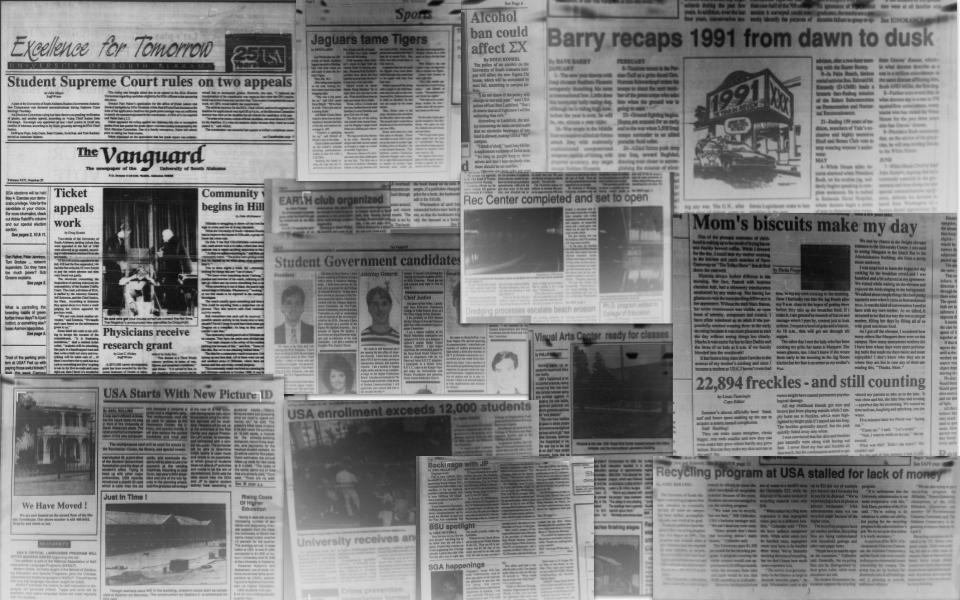
I have had the opportunity to work for “The Vanguard” for a little over five months. What started as another way to spend my time has recently become a passion of mine. I’ve always enjoyed writing essays, short stories, journals, and all! I told myself that writing for “The Vanguard” wouldn’t be any different besides a few daunting interviews, but to my surprise, the interviews weren’t daunting at all. Rather, they were enlightening.
After having a few articles under my belt, I can say, without hesitation, that “The Vanguard” is more than just a school paper. “The Vanguard” is our history.
I recently began writing a story that involved extended research. By research, I mean reading through the microfilm of “The Vanguard” dating back to 1986. I’ve viewed physical copies of “The Vanguard” from the 2010s and have accessed articles via disc drive.
Alas, I am still working thoroughly to find specific pieces that are critical to the story I am trying to tell. It became evident during this process that “The Vanguard” is the only source of documentation on this particular subject.
A familiar narrative that is heard when discussing history is that it’s taught to preserve the past and to keep it from repeating itself. “The Vanguard” has and continues to tell our stories. Through them, our legacies on campus live on.
The stories that I have read so far are priceless. They perfectly encapsulate the spirit and drive that has transformed the University into what it is today, from forming student organizations to constructing residence halls. Through these articles, I’ve essentially seen our school grow from the ground up.
The most exciting part of my journey with “The Vanguard” has been watching the paper revert to print again, an aspect that I appreciate more than ever after having had the opportunity to see its original state. As you may or may not know, the paper halted printing in 2019 due to the pandemic.
A school is not a school without its students. Neither is “The Vanguard.” This paper is created by the students, for the students. It can raise awareness and give a voice to the voiceless.
Students can access older issues of “The Vanguard,” along with other archives, through the Marx Library. The microfilm and discs are available on the second floor. Students can borrow discs through the circulation desk. The microfilm is also available on the third floor of the Marx Library in the Doy Leale McCall Rare Book and Manuscript Library. Appointments are required to visit the McCall. To make an appointment email mccalllib@southalabama.edu or call (251) 341-3900. To “ask a librarian” call (251) 460-7028 or email webref@southalabama.edu. A chat feature is also available on the Marx Library website.
 Jag Media