
By: Emory Waye, Contributing Writer
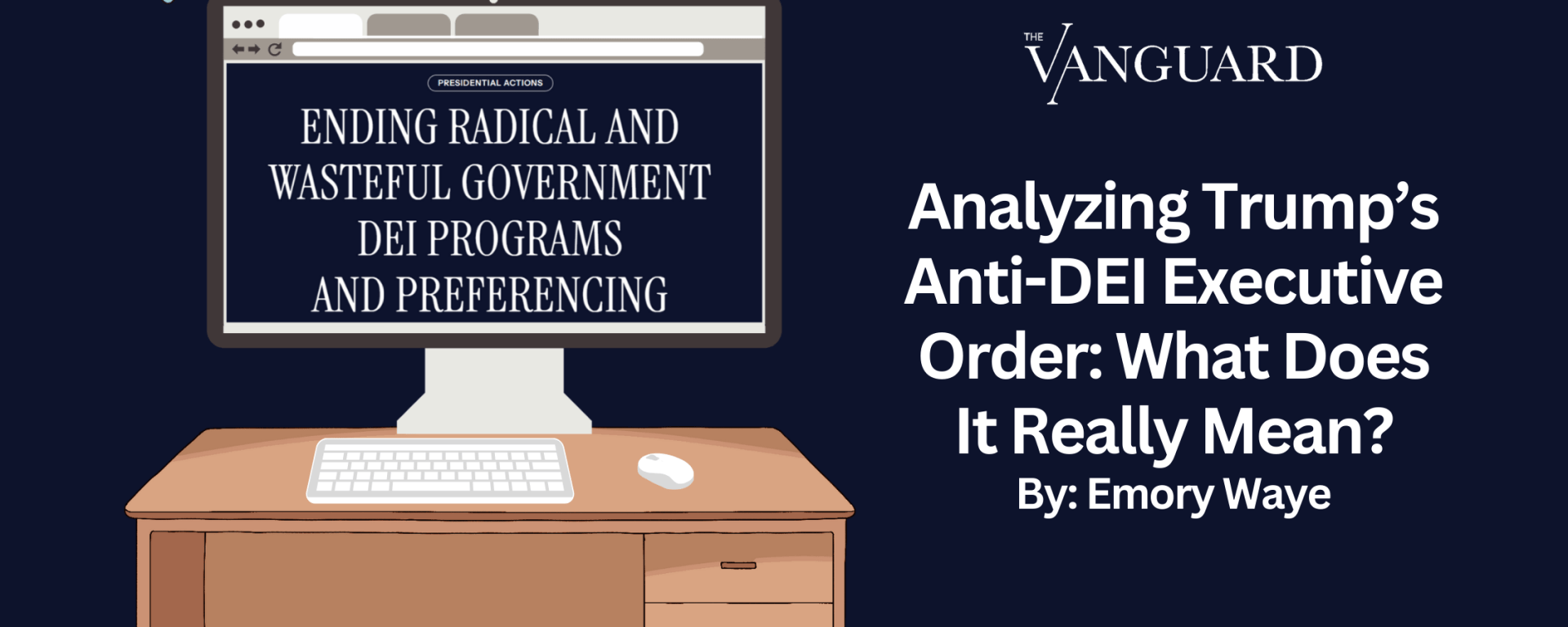
On Jan. 20, 2025, President Donald J. Trump signed an executive order titled “Ending Radical and Wasteful Government DEI Programs and Preferencing,” aiming to eliminate all diversity, equity, and inclusion (DEI) programs implemented by the federal government. The order, which can be found on the Official White House website, includes rescinding previous orders made by former presidents Joe Biden and Lyndon B. Johnson, as well as ending what he refers to as “illegal and immoral discrimination programs.”
One of the rescinded orders was Executive Order 11246, titled “Equal Employment Opportunity.” It was originally signed into law by President Johnson in 1965. The law ensured that Americans would receive equal treatment in employment, promotion, demotion, transfer, recruitment, layoff, termination, compensation, and selection for training. They could not be discriminated against based on their race, color, religion, sex, sexual orientation, gender identity, or national origin.
Trump’s order is implemented under the idea of restoring “individual dignity, hard work, and excellence.” The President’s order implies that DEI laws encourage employers to hire based only on diversity requirements and that contractors are pushed to “balance” their workforce with diversity quotas. However, job qualifications exist regardless of a potential hire’s race, gender, color, etc. It was already illegal in the United States to mandate specific numbers of hires based on race, gender, and other factors prior to Trump’s order. Executive Order 11246 required proactive steps to ensure fair hiring, but it did not require specific numerical quotas. In the Supreme Court case City of Richmond v. J.A. Croson Co. (1989), the court struck down a 30% minority quota, ruling that setting aside jobs for minorities was unconstitutional, and that rigid quotas are illegal. Another Supreme Court case, United Steelworkers v. Weber, involved a private company being sued for reserving 50% of their spots for black workers. The Supreme Court did not strike down the program in this case because it was implemented temporarily in order to fix past discrimination. Government-imposed quotas, therefore, have always been and will always be illegal.
So, what will Trump’s order actually accomplish if hiring quotas were already illegal? Fortunately, recent executive orders will not knock down federal antidiscrimination laws such as Title VII without action from congress. Title VII prevents employees from discriminating based on race, color, religion, sex, or national origin. This does leave out protection based on sexual orientation and gender identity, but the Supreme Court case Bostock v. Clayton County (2020) still ensures that gender identity and sexual orientation are protected under Title VII, and Trump cannot overturn the Supreme Court ruling with an executive order. While LGBTQ+ members are still protected under Title VII, Trump’s order titled “Removing Gender Ideology and Restoring the EEOC’s Role of Protecting Women in the Workplace” might weaken protections. The EEOC (Equal Employment Opportunity Commission) is in charge of upholding Title VII. Even though protections exist, LGBTQ+ rights may not be as prioritized under Trump’s administration. Protections for LGBTQ+ employees are also enforced by the state, as some states have anti-discrimination laws that go beyond federal protections. The states with the strongest protections include California, New York, Washington, and Oregon.
WhiteHouse.gov suggests that the reason behind this order being signed into action is to “protect civil rights” and keep contractors from “engaging in illegal discrimination.” While some Americans applaud this return to “fairness” and perceived protection of civil rights, others fear that their own rights to equality and equal opportunity in the workplace will not be enforced and that future orders may do away with even more legislative protections.
 Jag Media