
By: Jason Duke and Emily Morgan, Contributing Writers
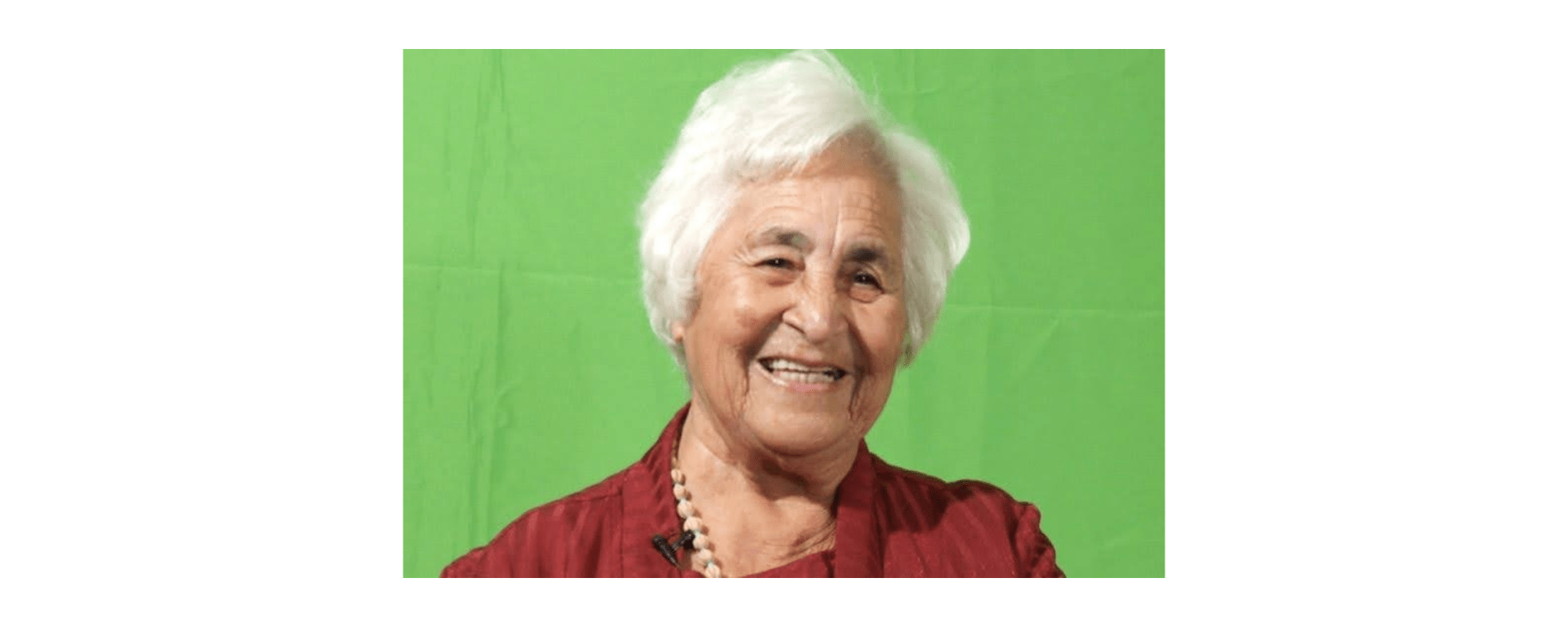
Feature photo of Ms. Ernestine Daughtry (1929-2019), courtesy of Deidra Dees
“‘Enokequa sulga’ – my heart is sick,” said Coffee, a Creek/Mvskoke man in 1838. At a Christian revival, he fell to his knees before the altar and wept. Reverend Joseph Camp, who documented this, had no way of communicating with the man, as Coffee did not speak English. Still, the Reverend had no questions as to what brought about the man’s sorrow. Coffee was one of the few Mvskokes to remain on his ancestral homeland here in present-day Alabama after the forced Removal of Mvskokes to the west on what is known as the infamous “Trail of Tears.”
“‘To think that his people were all in the West […] and he, with his wife and few others, left behind, cut off from his associates, and he weeping so bitterly,’” Dr. Christopher D. Haveman reported in the course textbook, “Rivers of Sand: Creek Indian emigration, relocation, and ethnic cleansing in the American South,” which documented Indigenous Removal in the 1830s. A century later, that same faith brought together the descendants of those Mvskokes that remained, despite their fractured communities ravaged by poverty.
Dr. Karla Martin Dawson, the Community Services Division Director at the Poarch Band of Creek Indians, was a guest lecturer in Dr. Deidra Suwanee Dees’ History class (HY 290) on March 19, 2025. This course is a Special Topics course centered around Native American Studies. It specifically addressed Mvskokes that were divided by the Indian Removal Act of 1830.
Dr. Martin Dawson, a descendant of those who were not Removed, was raised in the Tribal community in Atmore, Alabama, just as her father was. A graduate of the University of North Carolina at Chapel Hill, Dr. Martin Dawson focused her doctoral research on the oral history of her Tribal community.
During her lecture, she talked about her grandfather’s generation, and what was important to them. For those who were left behind, like Coffee, what remained of their communities was fractured and divided. There was one thing, however, that brought these shattered communities together: religion.
Dr. Martin Dawson played audio recordings of her interviewees. She elaborated on one of her interview subjects being sent to boarding school in the 1930s. She said the local church, Saint Anna’s Episcopal Church, assisted in creating educational opportunities for the Tribe. In one instance, they sponsored a Tribal Citizen, Ms. Ernestine Daughtry, to attend Saint Mary’s Girls School in Tennessee.
“White people expected me to have a feather on or look like a stereotypical Indian,” Ms. Daughtry said.
At the University of South Alabama, nearly a century after Ms. Daughtry’s experiences at the Girl’s School, students in Dr. Dees’ Native American Studies course listened to Ms. Daughtry laugh and regale her experiences as a young woman, specifically regarding her fond memories at the church. Students were able to hear firsthand these experiences through oral history, bringing people together and preserving the history through the voices of those who lived it.
 Jag Media