
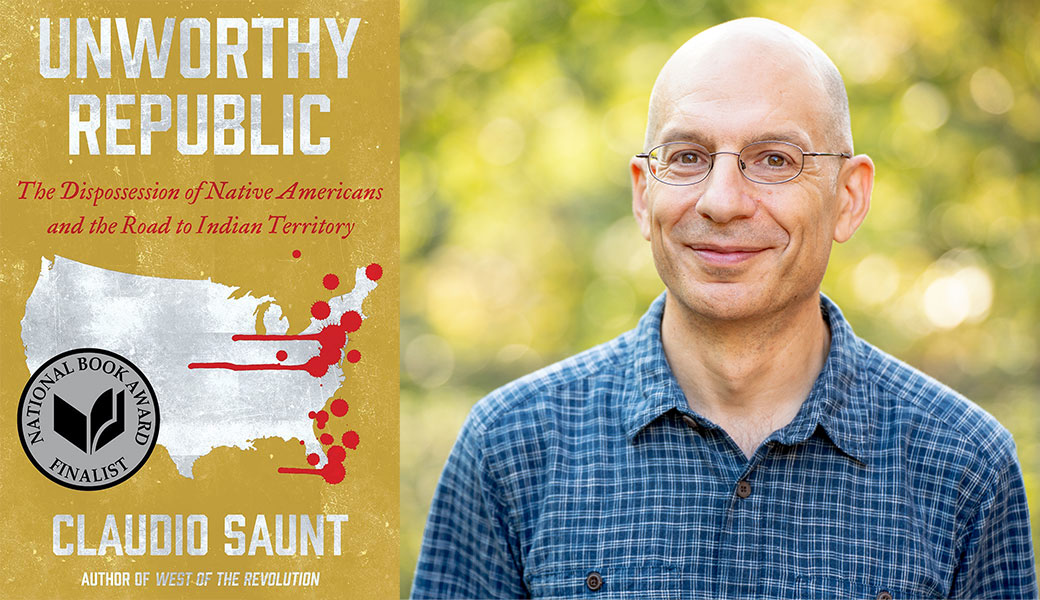
Article by: Nakeria Woods
On October 28, 2025, the University of South Alabama’s History Department held its annual Stallworth Lecture at the Laidlaw Performing Arts Center. This lecture is named after N. Jack Stallworth, a lifelong Mobilian and businessman. Stallworth’s love for Southern history and culture led him to establish the Stallworth Lecture, a yearly event where historians discuss their recent publications through the USA Foundation.
The lecturer for this year was Claudio Saunt. He is a history professor from the University of Georgia and specializes in Native American history. Professor Saunt is also a co-director of the University of Georgia’s Center for Virtual History, and the Richard B. Russell Professor of American History. In this lecture, Professor Saunt presented his recent book Unworthy Republic: The Dispossession of Native Americans and the Road to Indian Territory.
Professor Saunt began by detailing a personal story of his Hungarian Jewish ancestors and their experiences in Europe. This personal history inspired him to study the history of mass deportation and dispossession. Saunt aimed to recontextualize Indian removal and the ways it was justified and connected to the political project of the United States. This requires using more accurate vocabulary. Warriors become people and plantations become slave labor camps. Most important to this book, Indian removal becomes government sanctioned and sponsored extermination, expulsion, and deportation. Professor Saunt believes that this vocabulary is not only important in revealing the reality and brutality of these situations, but also because these terms would be used to describe “Indian removal” at the time. As he states, “the language we use to tell the story is peculiar, at worst obscures our perspective for seeing what it was.” Not telling the story of Native American expulsion with the language it deserves allows the United States to remain unblemished and presents this ultimate expulsion as inevitable for the creation of the modern state. As Saunt reveals, the expulsion of Native Americans was a turning point in American history and was the first state sponsored mass deportations of the modern era.
In this lecture, Professor Saunt highlighted three sections of the book, the early context, the dispossession, and finally, the ultimate relocation of Native people. For the early context, Saunt began in the 1820s with a very different and smaller United States. In the Deep South, Native Americans still owned significant territory, almost one-third of Alabama and Georgia and up to half of Mississippi. These lands were highly desirable and talks of expulsion had been happening since the early 19th century, but until the 1830s there was no federal government involvement in the deportations and expulsions of Native Americans.
Andrew Jackson disrupted this. Jackson was especially dedicated to the wishes and plights of southern slave owners, as one himself. Those who owned enslaved people dreamed of a transnational slave empire that went all the way to the Pacific Ocean and even into the Caribbean, with Cuba specifically being a target. They wanted more land, so they began to justify the expulsion of Native people as being the “best thing for them.” Professor Saunt’s point was that these southern slave owners wanted to be the masters of everything: land and people. Native Americans were a threat to this desire, not only through their ownership of land that was desired, but to the master-slave dynamic.
Despite all of this, state-sponsored native expulsion was still a very controversial issue. Though this was the generation of children and grandchildren of people who helped to expel Native peoples from New England, this new era of state-sponsored expulsion did not fit into the current perceptions of the United States. As a result, many people fought hard against the Indian Removal Act. This was the first mass mobilization of women in the United States. Even after all this opposition, the act would be passed only by five votes. Professor Saunt explained how this small margin victory was also connected to slavery. The three-fifths clause in the Constitution undemocratically gave the South and southern plantation owners more power in Congress. The expulsion of Native Americans and the institution of slavery were two aspects of the same story.
After providing this early context, Professor Saunt transitioned into discussing the dispossession of Native people. In the best cases, Native Americans would be offered lands in the West in exchange for their current land. In the worst cases, which were more frequent, there would be coercion and violence. The Army would be used to push people off their land and land speculators would use various exploitative tactics to trick Native people into signing over their land. This would not be without pushback from Native Americans, but ultimately most people would be removed.
Lastly, Professor Saunt discussed the relocation operation. As Professor Saunt explains, it was a hefty task to move entire communities, and the federal government would not properly rise to the task. There often was inadequate food, lack of clothes to meet the weather conditions, and rampant disease. The federal government did not have enough federal employees for the operation and often, the people in charge did not know where they were moving people. Saunt noted that all of this showed a complete disregard for the people being forcibly moved and the cruelty of the entire operation at every step. As Professor Saunt highlighted, this was the first modern deportation campaign. The core tenets of modern deportation; racial ideology or the desire for a monocultural state, the use of the government, and the global market, were all present in the expulsion of Native Americans in the 19th century. Imperial states admired the United States, Saunt revealing that the country was “the envy of many” in terms of how effectively the state removed people it found undesirable. To learn more about this topic, Claudio Saunt’s book, Unworthy Republic, is available online for purchase. As stated previously, the Stallworth lecture is hosted annually by South’s History Department. The event is open to all attendants and includes free refreshments. If the Stallworth lecture interests you, there is a similar lecture hosted by the History Department titled the Mahan lecture in the spring.
 Jag Media