
Article by: Nakeria Woods, Contributing Writer
Alabama is rich in civil rights history. The Montgomery Bus Boycott, the Birmingham Campaign, and Selma’s Bloody Sunday are all notable events in the national Civil Rights Movement. One significant city is missing from this list, though. As the second-largest city in Alabama and a significant port city with a sizable Black population, Mobile is rarely mentioned in conversations about civil rights. This can be justified as other Alabama cities had a much larger outburst of racial violence, but this does not mean that race relations in Mobile were good.
Mobile had very active civil rights organizations in the 20th century. A Mobile NAACP chapter was established in 1919, and over the next decade other organizations were formed. The most notable organization would be the John L. Leflore’s Non-Partisan Voters League (NPVL). Leflore had helped to revive the local NAACP chapter in the 1920s and became the chapter’s secretary. In 1956, Alabama officials successfully worked together to ban the NAACP from operating within Alabama because of its civil rights activities. This decision was eventually overturned by the Supreme Court in 1964, but this left Mobile without one of its most significant civil rights organizations. It was within this context that the NPLV gained prominence, headed by Leflore.
The NPVL, reflective of its leader, was defined by its “gentlemen’s approach,” as opposed to the confrontational direct action of other organizations like the Southern Christian Leadership Conference (SCLC). Leflore and the NPVL preferred to work with white liberal leaders and business elites. One significant relationship that Leflore formed was with Mobile commissioner Joe Langan. Langan’s opposition to the Boswell Amendment, an attempt to disenfranchise Black voters, as a senator in the Alabama State Senate garnered him support among Mobile civil rights leaders. In 1953, he became a Mobile commissioner, working closely with Leflore to attain the Black Mobilian vote. The best example of this was the “pink sheet,” which was a list of candidates that prominent Black leaders like Leflore supported, and was distributed by the NPVL before a local election. Langan maintained his commissioner seat largely due to these “pink sheets” and the Black Mobilian vote. The partnership of Leflore and Langan is popularly seen by Mobilians as exemplary of Mobile’s race relations, so much so, in fact, that in 2009, Unity Point Park was created featuring a statue of Leflore and Langan shaking hands.
But the simple narrative about Mobile’s moderate race relations represented by Langan and Leflore is much more complex. Black Mobilians were not completely satisfied by the pace of incremental reform in the city. In 1966, a group of civil rights activists decided to form a new Mobile organization, Neighborhood of Organized Workers (NOW), that focused on economic development and cleanup projects in the city’s neighborhoods.
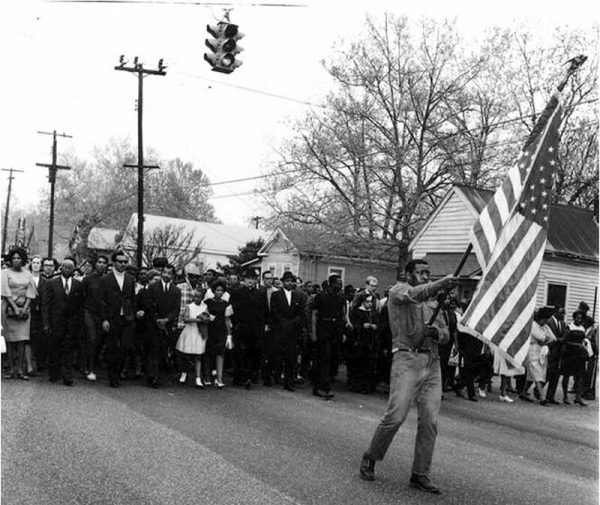
It would not be until the death of Martin Luther King Jr. in 1968 that NOW gained prominence. King’s assassination caused a mass response across the nation, including many uprisings in urban cities. In Mobile, Black people wanted to march in honor of the martyred civil rights leader. The city denied the organization’s request for a permit to march, yet on April 7, the march took place anyway. This was the first mass civil rights march in Mobile’s history, and NOW, under the leadership of Noble Beasley, officially adopted a direct-action-style strategy for combatting systemic discrimination and racism.
NOW was very different from the NPVL. Instead of adopting a “gentleman’s approach” of compromise, NOW used strategies such as picketing and boycotts of Mobile businesses and events to draw attention to the plight of Black Mobilians. Fredrick Richardson, the secretary and future president of NOW, stated in his book The Genesis and Exodus of NOW, that NOW was a “beacon of hope and inspiration for the nearly hundred thousand blacks in Mobile County.” NOW emerged out of the deep dissatisfaction that Mobile’s community had with its traditional Black leadership and offered a different pathway.
The organization’s “No Vote” campaign best demonstrated this. According to Richardson, the “No Vote” plan was an attempt to show white politicians and the Black community leaders who supported them that “the voting strength of Black people could no longer be taken for granted.” This campaign was very simple, as white politicians like Joe Langan continuously took the Black vote for granted; Black Mobilians would not vote at all in the 1969 municipal election. Not only was this tactic very unique, but it also undermined the power of the NPVL. Leflore desperately asked NOW’s officials to reconsider their voting boycott, but they refused. Ultimately without the Black vote, Langan was defeated by a far more conservative opponent.
There are two interpretations of NOW’s no-vote campaign. One view was the perspective presented by Richardson, that Black Mobilians had been taken for granted, and they needed to show their strength as a collective by abstaining from voting. The more popular narrative is that NOW was an organization of Black radicals who aimed to cause trouble by derailing the strong alliance between white liberal politicians and Black moderate community leaders. Within this view, the preexisting reasons for the campaign are disregarded, and Mobile is presented as a city that had little racial tension.
NOW had other successful campaigns, like their boycott of the America Junior Miss Pageant, but overall, the organization attained small wins in the form of convincing local businesses to hire Black workers. People like Commissioner Lambert Mims presented the organization as a group of dangerous radicals. Though the term “radical” was deployed negatively, there was some truth to this argument. NOW’s voting boycott and their surprising invitation of Stokely Carmichael, Student Nonviolent Coordinating Committee (SNCC) Chairman and Black Power activist, to speak at a general meeting was quite radical. Simultaneously, Mobile’s limited civil rights landscape positioned the group as far more radical comparatively, where at times the label was not as deserved.The radical label, whether deserved or not, would inevitably lead to the end of the organization. Prominent leadership in NOW was targeted with charges of drug trafficking and murder, crippling the group. By the mid-1970s, NOW was disbanded, the organization operating for less than a decade. NOW helps to reveal the ways that the historic view of Mobile as a racially moderate city obscures the complexities of the city’s racial history. Looking at the local history of places like Mobile reveals that the Civil Rights Movement was complex and looked very different from place to place. Analyzing local civil rights histories helps to complicate and deepen narratives about the Civil Rights Movement in the United States. To learn more about NOW, I recommend reading Fredrick Richardson’s book The Genesis and Exodus of NOW.

