
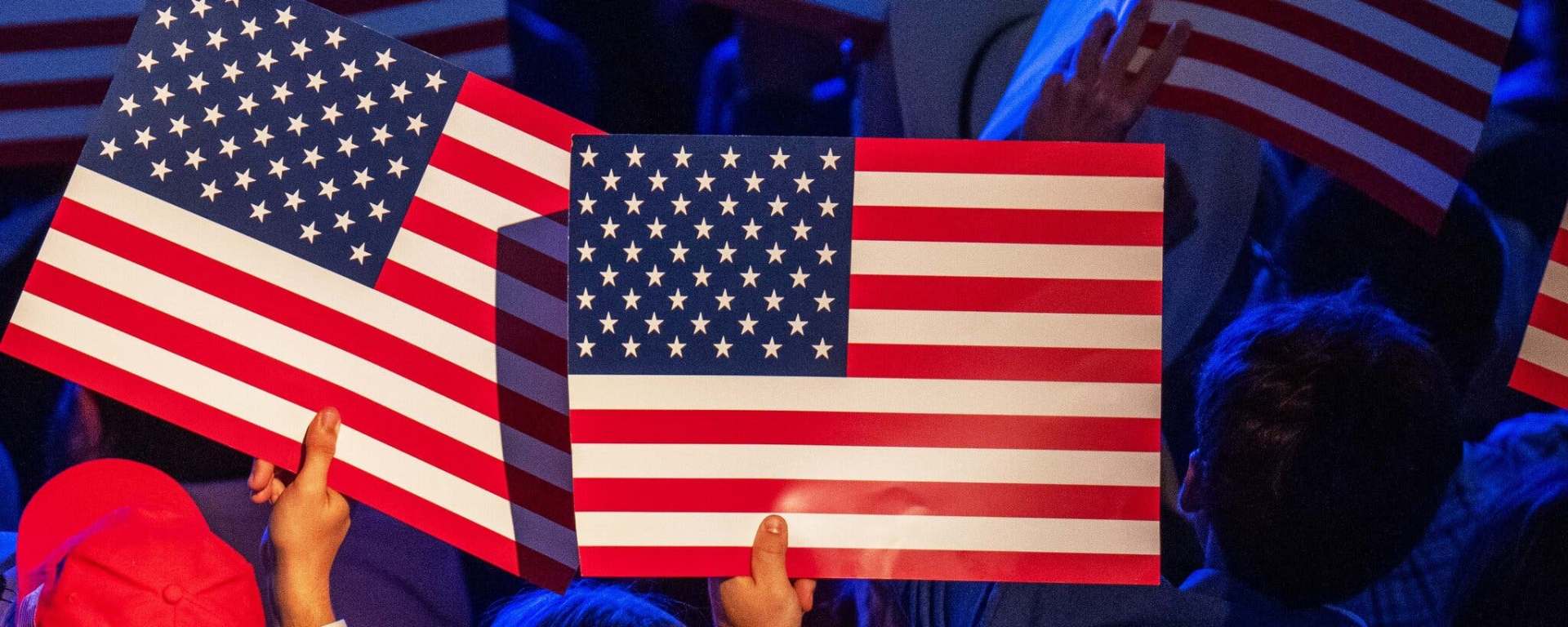
Article by: Robbie Kan, Contributing Writer, Photo by Ruth Fremson/NYT
Before the 2026 midterms, many expected a blue wave, but few could have predicted the level of turnover from just two years ago, when much of the nation was red. Driven by widespread voter frustration mainly with President Trump’s second-term policies, persistent economic anxieties and controversial overreaching executive actions, voters delivered a serious wake-up call on how they feel about Trump’s first two years of his second term. Now, narratives are going in all directions, confusing the public about where the partisan spin is going and where it actually stands.
To understand the different trends and how to comprehend the election, The Vanguard brought in Will Kaback, Senior Editor at “Tangle News.” “Tangle” is an independent, nonpartisan political newsletter designed to break down highly polarizing issues, giving a grounded approach to each and every story. As an editor writing many of his own articles and an instrumental part of “Tangle’s” success, Kaback offers a deep dive into election misinformation and gives his analysis, as well as some other important takes from this election cycle.
Here, we asked Kaback five different questions regarding the midterms.
Going into Election Day, polls suggested Democrats would win many seats, but not as many as they actually did. From your analysis, what results most surprised you, and what are some results that did not surprise you as much?
Kaback said that he was not surprised by many of the results, such as Michigan, South Carolina, Ohio and some swing states. He expected a strong Democratic showing, but he said he was surprised by the amount and volume that they ended up winning. Kaback believed that the Democrats would have the majority in the House but thought the Senate would be a toss-up, leaving moderate Senator John Fetterman, D-Pa., as a swing vote. Instead, Democrats will have a large Senate majority.
What are your predictions for how the next two years of Trump’s term will go?
Kaback said that he believes that if the Democrats had won a slim Senate majority as he expected, they would challenge a lot of Trump’s policies and be a roadblock to his agenda. Since they won so many seats, they will be able to do much more than that and pursue significant policy outcomes, including potential healthcare reform. He also added that the Democrats had a very good strategy this year of getting candidates who embodied the values of each swing state, as well as Republican states. The candidates’ priorities and personal backgrounds met the cultural and economic values of their state.
Since Trump convincingly won the popular vote last election cycle, and now the Democrats overwhelmingly won, do you think that we are seeing a massive party realignment? Are these moderate swing voters simply reacting to the party in power, or is it something bigger?
When asked this question, Kaback responded by saying that he does not believe that this is a huge party realignment and the United States, as a whole, is not turning blue. Kaback made a point to mention how in 2024, Trump won decisively and that a lot of people voted red. Because many people are unhappy with the Trump administration, specifically citing the handling of the Iran war and “internal corruption,” he lost a lot of the swing voters or independent voters who had previously sided with him. Kaback also said that, as well as losing many of the swing voters, many Republican voters or voters who usually would vote red flipped, helping lead to the massive blue wave.
What are common mistakes and errors that you are seeing news coverage make, on both the left and the right?
Kaback identified the most common issue he sees across both sides of the aisle as “confirmation bias,” where outlets will reinforce audiences’ existing beliefs while ignoring contradictory evidence. He said some other common examples are “disproportionate” attention to controversies when there are other developments with greater implications to cover. He also added that more biased outlets will rely too much on partisan sources and take them at “face value” instead of analyzing them before reporting or broadcasting the information.
“When breaking election news is surrounded by conflicting claims or potential misinformation, what is your step-by-step process at “Tangle” for vetting viral narratives before deciding how—or if—to report on them?”
Kaback said that “Tangle” makes a specific effort to verify information before believing it or assuming it’s factual. If it’s an anonymous account on Instagram, then most of the time it will be unfounded. Though if it’s a left or right-wing account or media influencer, that’s when “Tangle” will start taking it more seriously. Still, Kaback said that it could be false, or more likely it has grains of truth, and more research will be necessary to actually find out the validity of the claims.
For readers interested in non-partisan political coverage and multi-perspective analysis, additional articles, and daily newsletter editions, visit this link at https://www.readtangle.com/.

