
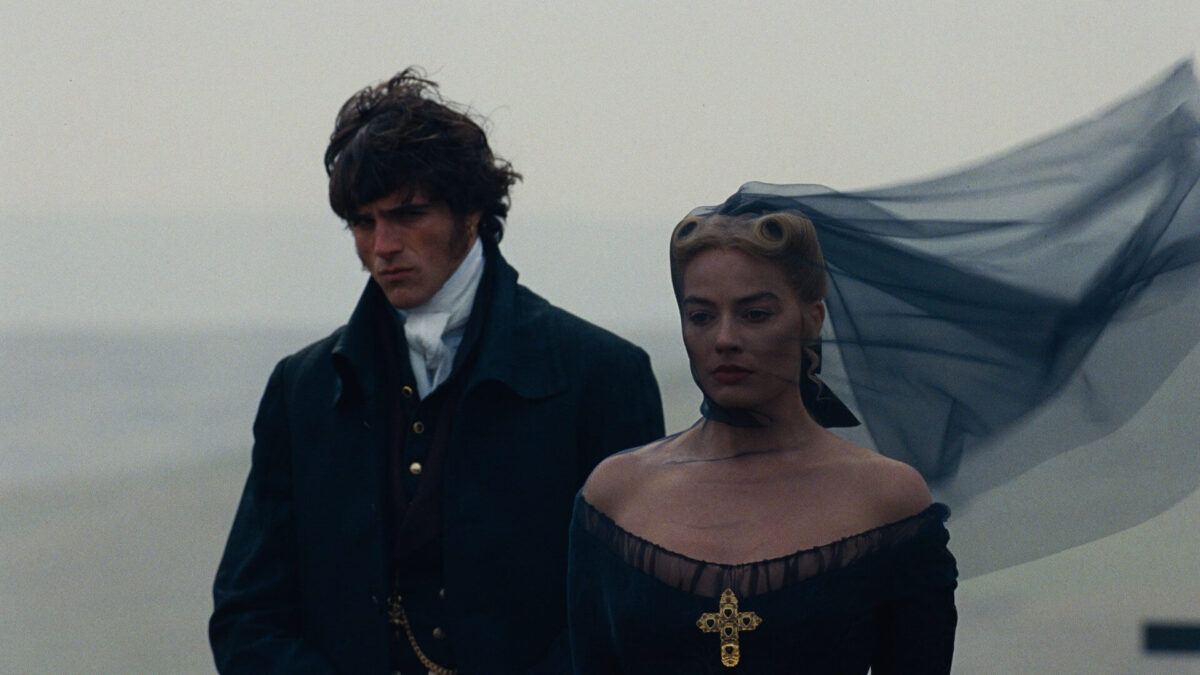
Article by: Ans Stork, Contributing Writer
Whether you liked Emerald Fennell’s adaptation of Wuthering Heights, or didn’t (like critics who have read the novel), there are several changes that take place in the film that don’t line up with the book. Some people, who most likely did not read Charlotte Brontë’s 1847 novel, praised the film for its “stunning visuals” and “outstanding cinematography.” The differences are major, and anyone who has read the book can pick them out in a heartbeat.
But First, A Look at the Novel
The novel takes place between 1771 and 1802 in the Yorkshire Moors in northern England, narrated by Mr. Lockwood, the tenant of the second estate, Thrushcross Grange. In Part I, we follow Heathcliff as he was taken to Wuthering Heights by Mr. Earnshaw, Catherine’s father. Nine years later, Heathcliff runs away. Catherine marries Edgar Linton at seventeen. Seven months later, Heathcliff returns to Yorkshire in September. In February of the next year, Heathcliff marries Isabella, Edgar’s sister. The following month, Catherine dies giving birth to Cathy II, ending the first part of the novel.
Later in the year, Isabella gives birth to Linton Heathcliff. After, we skip ahead to 1797, where Hareton Earnshaw and Cathy II meet for the first time. She sneaks out of the Grange against her father’s wishes and finds herself at Wuthering Heights. That same month, Isabella passes, and Linton is taken to Thrushcross, then Wuthering Heights.
It is now March 1800, and Cathy meets Heathcliff and Linton for the first time. A year later, in August, Cathy marries Linton. Edgar passes that same month, and the next, Linton dies. Mr. Lockwood visits the Heights in November and returns to London in January. In April, Heathcliff dies and is buried next to Catherine, and Mr. Lockwood returns to the Grange in September, where Cathy and Hareton plan their wedding for January.
Heathcliff’s Racial Background
When the casting came out, English majors all over were shocked to see the main male character was being played by Jacob Elordi. This was in no hate to Mr. Elordi; however, people raised eyebrows at Fennell, who stated that she’s been “world-building since childhood,” according to Claire Valentine McCartney of W Magazine.
In the novel, Mr. Lockwood, the narrator, describes Heathcliff as a “dark-skinned gipsy.” Granted, none of the characters know where the mysterious Mr. Heathcliff came from, other than being discovered as a foundling in Liverpool, England. Mr. Linton, Catherine Earnshaw’s husband, refers to him as “a little lascar,” or an American or Spanish “castaway.” Historically, this term was used to describe South Asian sailors on European ships during the 16th to 20th centuries. So this points to Heathcliff as South Asian, but other scholars have theorized that he is Black, as Liverpool has a history of being a port city for Britain’s involvement in the transatlantic slave trade.
Even though there is ambiguity surrounding the character’s race, Brontë makes it clear that Heathcliff is not white. Changing his race removes a major theme and removes most of what happens in Volume One. Heathcliff was abused, mainly physically by his adoptive brother, Lindley, but also by being deprived of an education, and was forced to do hard manual labor. This background gives us reasoning for the actions he takes against his wife and others as an adult. In the novel, he is seen as an Other, so it gives Mrs. Earnshaw, Hindley Earnshaw, and the Lintons reason enough to degrade him.
Mr. Earnshaw/Hindley Earnshaw
In the film, Mr. Earnshaw is cruel to Cathy and beats Heathcliff so severely that he is left with permanent scars criss-crossing his back. Earnshaw is a drunk gambler who’s responsible for the couple’s inability to marry, as well as one of the triggers of their sadomasochist dynamic. His habits also cause his family to lose all their fortune after his wife dies.
In the novel, however, he loves Heathcliff more than his own son, Hindley, who does not appear in the film. He is the one who became an alcoholic and a gambler after his wife, Frances, died. When his father dies, and he inherits Wuthering Heights, it’s he who abuses Heathcliff.
Catherine and Heathcliff’s Ages
Elordi, who is 28, and Robbie, who’s 35, are not young enough to play Catherine and Heathcliff. Catherine meets Edgar, her husband, at 17, and she dies shortly after childbirth at 18. The film also shows the baby dying in utero, which doesn’t happen in the book.
With the novel taking place between 1771 and 1801, it does not make sense for the casting director to cast people ten times the characters’ ages. But the film was produced by LuckyChap, Robbie’s company, and after she read the script, she openly asked Fennell if she could play Catherine. In the 18th and 19th centuries, people married and had children at an early age due to shorter lifespans. A lot of adaptations of books mess up characters, just to cast someone popular to boost their viewings.
Wuthering Heights and Thrushcross Grange
Heathcliff gains ownership of Wuthering Heights after Hindley dies. He accomplished this by exploiting Hindley’s gambling addiction after becoming a mortgagee of the estate after he lent money to him to fund the addiction. He also gains the Grange following the death of Edgar Linton. He designs the marriage of his son, Linton Heathcliff, to Linton’s daughter, Cathy Linton, and forces her to stay at Wuthering Heights. Mr. Lockwood, the narrator and tenant of Thrushcross Grange, is cut from the film. In the novel, he finds it strange that his landlord chooses to live at the Heights, which he accounts would befit a “homely northern farmer.”
Wuthering Heights is not the most welcoming estate, as it is filled with a “whole hive” of snarling dogs, and it’s haunted. That’s logical because a haunted house is a major trope in Gothic literature. In the book, this is introduced when Mr. Lockwood sleeps in Catherine’s childhood bed and is visited by the ghost of Catherine Linton/Earnshaw in Chapter Three. She is seen as a child and grabs his wrist through a broken window, begging to be let in.
The film gives a surrealist take to both buildings, with high-gloss finishes to the stone, a room filled with only ribbons, and the mantelpiece made of plastered hands. Fennell gives an Alice in Wonderland vibe, unlike the earthy, Gothic vibe of the novel.
Catherine and Heathcliff ARE Sadomasochists, But…
When the film’s trailer came out, people were shocked at the explicit eroticism displayed. In an interview, Fennell addressed the trailer, telling the Brontë Women’s Writing Festival, “There’s a lot of sadomasochism in this book. There’s a reason people were shocked by it.” And she’s right. Before her father leaves for Liverpool when she is a child, she asks him to bring her back “a whip.” Instead, he brings back Heathcliff, whom she “grins and spits on.”
When Heathcliff returns to Yorkshire after three years, he finds that Catherine is married to Edgar Linton. To gain revenge against Edgar, as well as to secure ownership of the Thrushcross Grange, he marries Isabella Linton, his sister. He calls her an “abject thing” and tells Catherine he’ll only live with her in “a very ghoulish fashion,” turning “the blue eyes black, every day or two.” As I said, she’s his sister in the novel, but in the movie, she is his ward, which makes the revenge a little less personal. Also, when it comes to the degradation she faces at the hands of her husband, she enthusiastically consents to it in the film. In the book, she does not, though she does have a crush on Heathcliff due to his moodiness, but she isn’t a simple-minded woman with an obsession with dolls.
In Brontë’s novel, Heathcliff tricks Isabella into eloping, giving him an opportunity to inherit the Grange. Once they’re married, her husband shows his true side, going so far as to hang her dog. Elordi’s Heathcliff, on the other hand, collars and chains his wife and makes her bark like a dog, after he tells her he will “never love her” and “treat her abominably,” and even asks her four times if she wants him to stop.
The Lost Volume and Generation
The film, unlike several adaptations (such as Emily Brontë’s Wuthering Heights from 1992), the 2026 movie left out Volume Two. The second part of the book tells the story of Heathcliff and the second generation after Catherine’s death. Fennell’s film focuses on the relationship between Catherine and Heathcliff, and ends after Catherine dies. Volume Two follows Cathy II, Edgar and Catherine’s daughter, Hareton, Hindley’s son, and Linton, Heathcliff and Isabella’s son, as they are caught in the cycle of abuse.
After the death of the woman he’s been obsessed with, Heathcliff is determined to make everyone’s life miserable. He uses his dying son to lure Cathy II to the Heights, where Heathcliff imprisons her and coerces her to marry Linton, who are first cousins. Edgar dies shortly after Catherine, meaning that Heathcliff can now take over the Grange. He begins seeing Cathy’s ghost on the moors, stops eating, and wastes away on ecstasy. Meanwhile, Hareton and Cathy II, who are first cousins as well, are falling in love. Because of his mania, Heathcliff dies and is buried next to Cathy. Afterward, Hareton and Cathy II begin to set a date for their wedding and inherit the Grange.
Subduing Strictures
Though the trailer and film shocked viewers, it was tame compared to the novel. The book shares messages of necrophilia, incest, and animal abuse. Fennell cut the death of Isabella’s dog, Heathcliff digging up Catherine’s grave twice to lie next to her, and the romance between two first cousins. She loves to shock her viewers, and she did it in a different manner, toning down the Gothic tropes for erotic ones.

